This essay is telescopic. It can shrink or expand, depending on how much attention you are willing to give.
This is the original version (1407 words). Show other sizes.
Artificial Creativity Manifesto
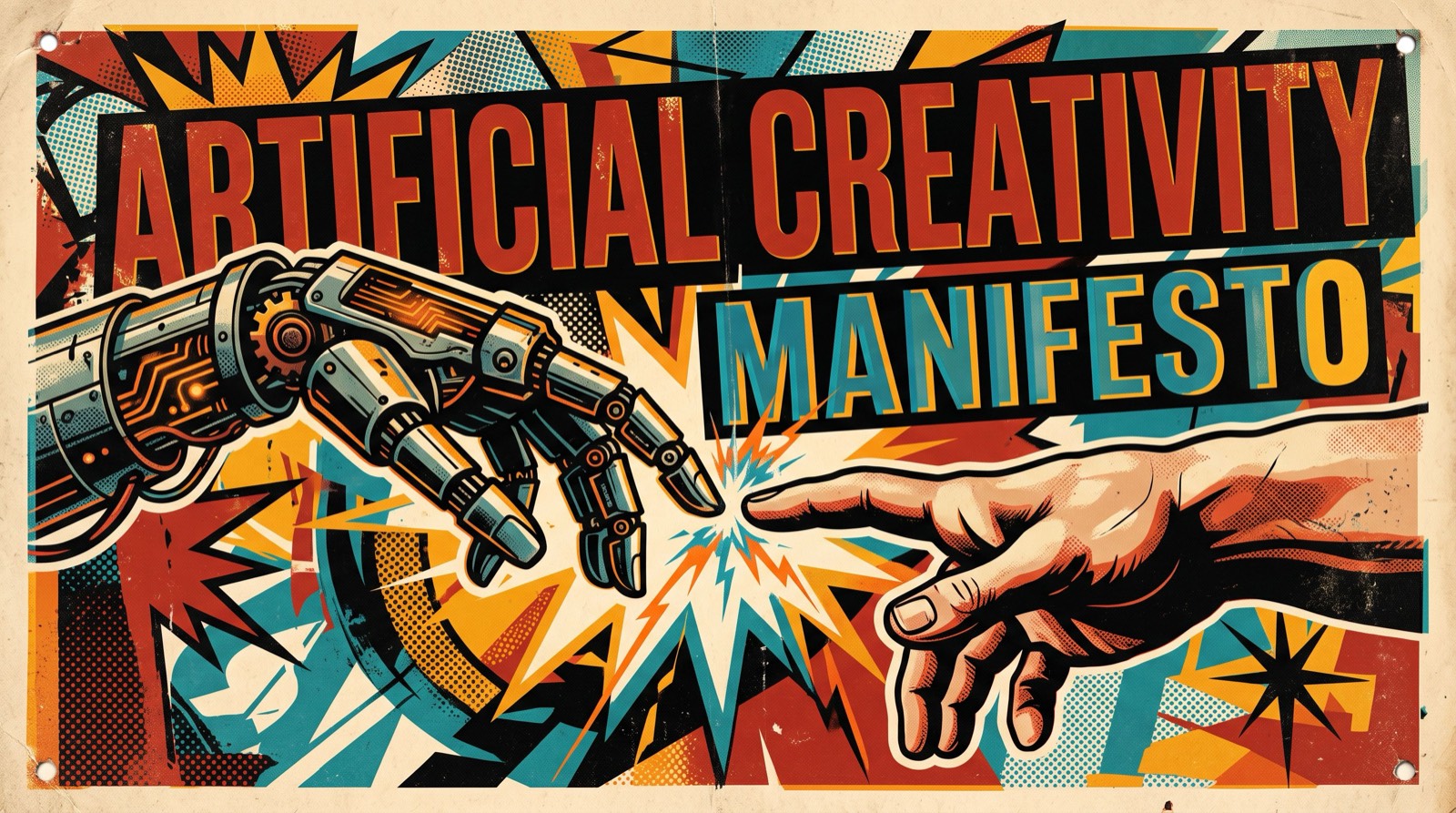
-
Artificial Intelligence is here. The next frontier is Artificial Creativity.
-
Current AI systems are great (and will get better) at coding, math, science etc. i.e. domains where there is a verifiable and context-independent correct answer or objectively optimal solution to strive for.
-
But in the process of optimizing AI systems for being great at reasoning, we made them terrible at being surprising, interesting, opinionated, funny, creative. It's time we start seriously looking at the other side.
-
Solving artificial creativity is not theoretically impossible. The words of Shakespeare are, in the end, also just a sequence of tokens. Their contextual novelty, their timelessness, their accumulated cultural significance are not the stuff of magic. It's the result of an interesting human having something interesting to say in a way that resonates with other humans.
-
Solving artificial creativity is not fundamentally unethical. Humans do not and never did hold the unique cosmic mandate on having interesting ideas. As Michael Levin and others continue to show, all sorts of systems (from cells to plants to animals and beyond) are constantly showing both intelligence and creativity in their own problem-solving spaces. Nature is wonderfully creative. Humans are just one voice for creativity, and adding another voice to the cosmic creative orchestra is neither a sin, nor an intrusion on human rights.
-
As a society we have to make sure that creative professionals (as well as all other humans) continue to have the means to live and feel fulfilled. But it's a terrible lack of imagination to say that the only way of achieving this is to ban artificial creativity and lock in the perpetual scarcity that keeps creative people employed in shitty half-interesting jobs. What we really want is for creative people to be able to go and write a novel that they always wanted to write, not work till 2am writing advertising copylines for a brand they don't care about.
-
Solving artificial creativity unlocks a lot of value downstream. If we have a system that can create novel, unexpected ideas, content and experiences that don't look or sound like everything else, if we can create a system that reliably creates unexpected lateral connections and makes people feel diverse things more intensely - we can facilitate the growth in all the creative industries: gaming, movies, literature, science and beyond (all the places where the primary bottleneck for growth is increasingly the quality of ideas and stories, not the quality or cost of execution). Importantly, we should do our best to facilitate growth by making creative professionals currently engaged in these industries more valuable, rather than less valuable, and at the same time more fulfilled, rather than less fulfilled. A good historical example of this is what happened to painting with the arrival of photography. When painters were freed from the job of accurate depiction, they invented whole new areas of art. And from a commercial standpoint, today we have more professional artists per capita than we did in the pre-photography days. And (more importantly) we have a lot more people enjoying painting as a hobby (getting creative fulfillment from it).
-
Subjectivity and context-dependence of creativity are a fundamental feature of this problem, not a bug. If we are to solve artificial creativity, we need to lean into the human on the other end of the transmission. Creativity is not a universal optimization problem that can be solved by gradient descent once and for all. A radically different approach is required.
-
The core measure of creativity of a piece of content or experience is the intensity of feeling it generates in you when you are exposed to it. Not "the audience", but you (a singular human at this singular moment). The artificially creative system needs to incorporate some kind of model of the audience in context, so that it can optimize for subjective in-the-moment novelty, surprise, interestingness, and correctly balance the need for familiarity with the need for surprise.
-
Prior work in the field (Boden, Schmidhuber, Colton etc) has outlined some theoretical approaches, but no serious effort has ever been put behind making truly artificially creative systems that actually work in the real world and prove their value at scale and in a variety of contexts. Studies that show that humans on average tend to prefer AI poetry to human poetry only show that all poetry is failing at creating truly intense feelings reliably. We are not trying to beat the benchmark for an average human. The goal is to find a scalable way of making individual humans lose their breath, or start dancing, or cry or send something to everyone they know.
-
To attack the problem of artificial creativity we need to assemble a cross-functional team of machine learning experts, artists, psychologists, neuroscientists and commercial creatives. We need to start small (focus on short form text) and design hybrid (human + machine) systems first that can show commercial viability in producing reliably better (i.e. more interesting, more culturally relevant, more engaging) ideas for commercial creativity contexts. We will need to go through dozens of experiments and adaptable system designs, as the full artificially creative system will by definition NOT look like a single set of weights (one ML model), but rather like a complex organism with lots of randomness, various real-time inputs, multiple ML models etc.
-
We will need to be constantly vigilant to avoid the two deadly traps: mistaking engagement time for the depth of emotional resonance and mistaking shock for surprise. We are not here to generate clicks or seconds on the platform. We are not here to create digital drugs. We are not here to push evolutionary buttons. We do not want to build a system that helps people amuse themselves (or scare themselves) to death. The goal of the system is to maximize the depth and diversity of emotions and experiences that people will remember in a way that is sustainable over the long term. There is no clear single metric that can capture this goal, but the closest we can imagine for now is Lifetime Fond Memories (LFM) - how many fond memories does a human accumulate over a lifetime from interacting with the outputs of the artificially creative system?
-
The third deadly trap we will need to avoid along the way is the trap of presuming the audience is passive. If we are optimizing for Lifetime Fond Memories, if we are really focused on creating diverse, emotionally deep moments worth remembering - then we have to recognize that some of the best such moments come not from "consuming content", but from creating or co-creating it - together with other humans, other natural intelligences (animals, plants) and artificial intelligences (machines). The rise of artificial creativity does not mean the death of human creativity, just like the rise of human creativity didn't mean the death of the creativity of Nature. If we succeed in our mission, then the amount and quality of human creativity (and the joy from it) will grow exponentially, because more humans will have a better chance to experience artistic fulfillment.
-
Once the system is proven at the minimal scale of creating better ideas in the contexts of commercial creativity (e.g. practical design, brand advertising etc.), we should scale the system towards more consequential domains of culture (gaming, product design, books, movies, etc.). As AI and robotics free more time for humans, the key battle will be the battle against uniformity and boredom. Our systems will need to form the foundation for continued human victory in our struggle against boredom and the dull uniformity of monoculture.
-
Solving artificial creativity is an existential question for our culture. If we solve it - the future culture will be more diverse, more novel, more interesting, and more participatory. If we can't solve it - human culture will continue its descent into the black hole of middle-of-the-average self-reinforcing cliche and slop (now accelerated by AI, but very prominent before AI too). We can't and shouldn't stop AI. But we can create a counter-force to it: Artificial Creativity (AC), ensuring our descendants (human and artificial) will not have to live in a world of reduced emotional range, boredom and predictability, but will rather enjoy ever more diverse, interesting, breath-taking, fulfilling and memorable lives.
-
How does this make you feel?
Original published: July 27, 2026